Racing Wheel vs Controller: Which Is Faster for Beginners?
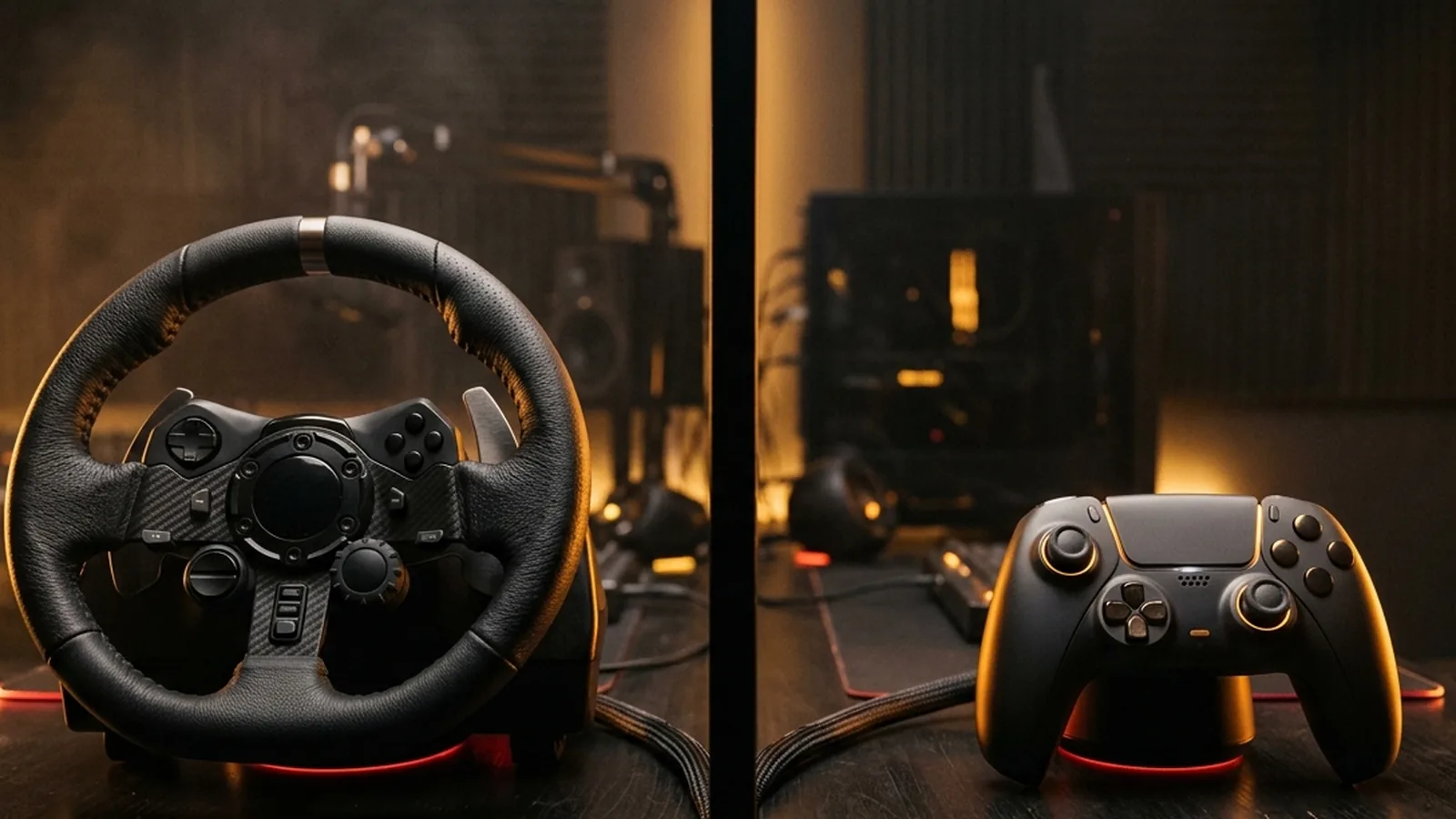
Racing wheel vs controller: a wheel is usually better for consistent lap times once you have practised, while a controller is usually quicker to learn on day one. A wheel gives finer steering and progressive pedals. A controller is cheaper, easier to carry and perfectly capable in many games.
In short
- A controller is faster to pick up in the first session; a wheel tends to win after several sessions.
- A wheel gives finer steering and pedals you can press by degrees, which helps with braking.
- A controller can be very quick in games designed for it, and it is cheaper and easier to store.
- Wheels with force feedback let you feel the car losing grip; controller rumble gives only a rough hint.
- If you can try both on the same game, do it before you buy.
Most people asking this question have a game, a few free evenings and a nagging doubt: will a wheel make me faster, or just feel more like driving? This post compares the two on what actually decides lap times: steering precision, braking control, feedback, learning time and practicality. It also gives you a simple rule for choosing and a way to test the difference yourself in one sitting. We are not claiming one is better in every case. The right answer depends on the game and on what you want from it.
Which is faster, a racing wheel or a controller?
A wheel is generally faster over time and a controller is generally faster on your first day, but the gap depends heavily on the game. In the first hour, a pad is familiar: you press a stick and the car turns. A wheel asks your arms and feet to learn new habits, so early laps are often slower.
After that, the picture changes. A wheel moves through a large range of angle, which means small differences in steering produce small differences in direction. A thumbstick moves a few millimetres, so the same fine control is harder. The pedals matter as much: braking by degrees is a core skill, and a pedal offers more range than a trigger.
Does that always make a wheel faster? No. Some games are tuned around controllers and handle them very well. Reading how one racing site frames it helps; see The Race's controller versus wheel debate for the competitive-sim view. Treat any claim of "always faster" with caution, including ours.
Racing wheel vs controller: how do they compare side by side?
The table below compares the two across the things that affect a beginner most.
| Factor | Controller | Racing wheel and pedals |
|---|---|---|
| First-hour speed | Usually quicker | Usually slower |
| Steering precision | Good, limited by stick travel | Finer, with a wide range of movement |
| Braking and throttle | Triggers, short travel | Pedals, longer travel and more control |
| Feedback | Rumble, a rough hint | Force feedback in many wheels, more detail |
| Space and set-up | Fits in a bag | Needs a desk or frame and clamping |
| Cost | Low, you may own one already | Higher, and rises with quality |
| Best fit | Casual play, small spaces | Regular practice, sim-style games |
Nordic Game Supply's controller or wheel guide for 2026 covers the same decision from a retailer's perspective, which is worth reading alongside this.
Why does steering feel so different?
Steering feels different because a wheel maps your hand movement one-to-one to the car, while a stick maps a tiny movement to a big change. If you turn a wheel ninety degrees, the virtual wheel turns accordingly. On a stick, ninety degrees of steering lock may be a few millimetres of thumb.
That has two consequences. A wheel lets you make small corrections naturally, and a controller game often adds assists (steering smoothing) to make up for the short travel. Those assists are helpful but they also hide information: the game is doing part of your job.
The second consequence is physical. Using a wheel for an hour uses your shoulders and forearms, not only your thumbs. Plan to be tired, and sit with your elbows slightly bent.
What does force feedback add?
Force feedback adds information: the wheel pushes back to show what the front tyres are doing. The Wikipedia page on force feedback covers the general concept. In practice, you feel weight build in a corner, and you feel the wheel go light when the front tyres begin to slide. That light feeling is your early warning for understeer, which we explain in oversteer and understeer explained.
A controller can only vibrate, and the vibration is more of a cue than a measurement. You learn to read the screen and the sound instead. That works, but it is slower to develop.
Not every wheel has force feedback. Basic wheels use springs to centre the steering and give little detail. If feedback matters to you, check the product description rather than assuming.
Mistakes people make when buying a wheel
Most bad choices come from buying before testing. Watch for these:
- Buying the cheapest wheel and expecting a transformation. A basic wheel with weak pedals can feel worse than a good controller.
- Ignoring desk space. A wheel that slides around or wobbles teaches bad habits.
- Changing three things at once. If you switch device, car and track together, you cannot tell what helped.
- Judging after one session. A wheel needs a few sessions before the benefit shows.
- Leaving all assists on forever. Reduce them gradually as you improve.
The Flow Racers wheel versus controller article is another useful read on this point.
How to decide: choose X if, choose Y if
A short rule works for most people.
- Choose a controller if you play racing games occasionally, have little space, or want the lowest cost. Also choose it if you mostly play games built around pads.
- Choose a wheel if you want to improve at sim-style games, practise several times a week, or enjoy the feeling of driving. Also choose it if you already know you like racing.
- Try both first if you are unsure. A lounge lets you do this without buying anything.
There are edge cases. If you have a physical limitation that makes a wheel uncomfortable, a controller is a perfectly good choice. If you share a room, noise and clamping may rule out a loud wheel at home.
A simple test you can run in one session
You can measure the difference yourself with a fair test. Choose one car and one track. Drive ten laps on a controller, then ten laps on a wheel, and write down your best and your average lap time for each.
Do not compare the first wheel laps with the last controller laps, because you will have warmed up. Instead, repeat the test on a second visit and compare again. Many beginners find the wheel is slower on visit one and equal or faster by visit two or three. You might find the opposite for a particular game, and that is a valid result.
Also note how you feel. If the wheel makes the game more enjoyable, that counts, even if the lap times look similar.
How this works at Playsole
Playsole Gaming Lounge has racing-simulator rigs with a wheel and pedals, as well as gaming PCs and PlayStation 5 (PS5) consoles. That means you can try a wheel without buying one. Most simulator stations seat one player. The games and the equipment vary by outlet, so check what each outlet offers.
On the booking page you can see live availability for Playsole Kharghar and Playsole Vile Parle, filter by machine type or by game, and choose a start time and session length. Sign in with your email to book. You will get a confirmation code to show at the counter. If you want a fair comparison, book a racing rig for one session, and ask at the counter how the controller options work at that outlet. Our gaming cafe near me checklist lists what to verify before you travel.
FAQ
Is a racing wheel better than a controller?
For regular practice at sim-style games, a wheel is usually better because of finer steering, progressive pedals and force feedback. For casual play or limited space, a controller is a good choice. The best option depends on the game, your budget and how often you play.
Can you be fast with a controller?
Yes. Many racing games are designed around controllers, and skilled players set very quick times with one. A controller limits how finely you can steer and brake, so the ceiling is usually lower in demanding sims, but it is not a barrier for most beginners.
Do I need force feedback to start?
No. You can learn the basics of lines, braking and smooth inputs without it. Force feedback helps because it tells you what the front tyres are doing, which speeds up learning. If your budget is tight, prioritise a stable mount and decent pedals first.
How long does it take to get used to a wheel?
Most people feel awkward for the first session and noticeably more comfortable by the third or fourth. Practise short stints, keep one car and track, and focus on smooth inputs. Everyone adapts at a different pace, so judge your progress by clean laps rather than by speed.
Is a wheel worth buying for a few games?
It depends on how often you will use it. If you play racing games weekly, a wheel can be worth the cost and space. If you play now and then, trying one at a lounge first is a cheaper way to find out whether you would use it.
What should I try first, a wheel or a controller?
Try the one you do not own. If you already have a controller, book a wheel session and compare. If you have only played on a wheel, try a pad for ten laps. Using the same car and track gives you a fair view of what each one does.
Next step
The fastest way to settle racing wheel vs controller for yourself is one measured session on each. Open the booking page, choose a racing rig at your nearest outlet, and drive ten laps with one car and one track. Write down your best lap.
If you are new to the whole idea, start with what is sim racing. If you already know you want to improve, sim racing tips for beginners gives you a practice routine for your first clean lap, and you can come back to the comparison once you have real lap times.